CIP (Common Industrial Protocol)
Table of contents
Overview
The Common Industrial Protocol (CIP) is a peer to peer object oriented protocol that provides connections between industrial devices (sensors, actuators) and higher-level devices (controllers). CIP is physical media and data link layer independent. See Figure 1-1.1.
Network
└── Device (MACID = 5)
    └── Class (Class ID = 0x01 - Identity)
        └── Instance (Instance ID = 1)
            └── Attribute (Attribute ID = 1 → Vendor ID)
            └── Attribute (Attribute ID = 2 → Device Type)
            └── Attribute (Attribute ID = 3 → Product Code)
            └── Attribute (Attribute ID = 4 → Revision)
        └── Instance (Instance ID = 2)   ← Rare, but possible
    └── Class (Class ID = 0x04 - Assembly)
        └── Instance (Instance ID = 100)
            └── Attribute (Attribute ID = 3 → Input Data)
    └── Class (Class ID = 0x25 - Motor Data)
        └── Instance (Instance ID = 1)
            └── Attribute (Attribute ID = 3 → Run Status)
Typesofcommunication EtherNet/IP offers two maintypesofcommunications: Explicit and Implicit. Explicit Messaging • CommunicationProtocol: TCP/IP • Connection: CanbeConnectedorUnconnected • Nature: Request/reply transactions, typically for non-real-time data. • Flexibility: Highly flexible, includes descriptive info, making it less efficient. • TypicalUse: Reading/Writing configuration information, HMI data collection, etc. Implicit Messaging • CommunicationProtocol: UDP/IP • Connection: AlwaysConnected • Nature: Real-time I/O data transfers, time-critical. • Flexibility: Less flexible but more efficient, as little to no descriptive info is included. • TypicalUse: Real-time control data from remote I/O devices
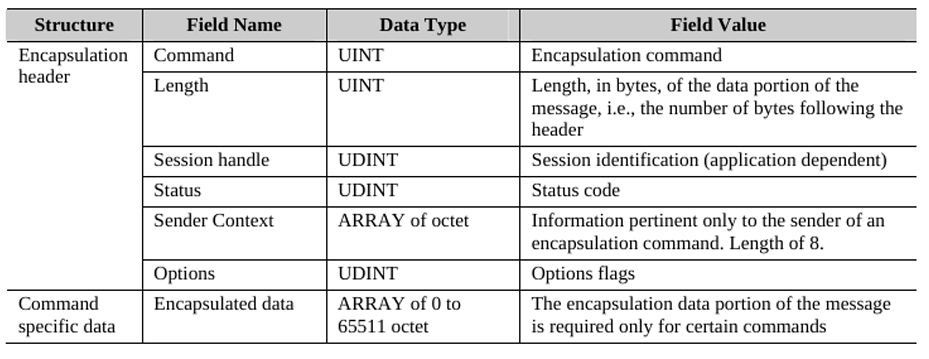 Encapsulation • There’snoexplicit information in the headertodistinguish betweenarequestandareply; it’s determined either implicitly by the command and context or explicitly by the contents of an encapsulated protocol packet in the data part. • Fields are transmitted in little-endian byte order. • Encapsulation messageshaveafixed-lengthheaderof24bytesandanoptionaldataportion. • Thetotal length of the encapsulation message, including the header, is limited to 65535 bytes. • Thepacketstructure goes asfollows:
Status field • TheStatusfieldindicates the success or failure of executing an encapsulation command. • Azerovalueinareplymeanssuccessfulexecution. • All requests from the sender shouldhaveaStatusfieldsettozero. ** • Non-zeroStatus in arequestwill be ignored bythereceiver, and no reply will be generated.
four networks - DeviceNet™, ControlNet™, EtherNet/IP™ and CompoNet™ - use the Common Industrial Protocol (CIP) for the upper layers of their network protocol.
file:///C:/Users/Eric/Desktop/CIP/ilide.info-cip-vol1-3-3-pdf-pr_922db433048f593c4043848877401e27.pdf#page=1231
https://www.odva.org/wp-content/uploads/2020/06/PUB00123R1_Common-Industrial_Protocol_and_Family_of_CIP_Networks.pdf#page=15
Device Identification
